


By JKV Travel
Nestled deep within the mystical Nallamala Hills, on the serene banks of the River Krishna, lies one of India’s most powerful and spiritually charged destinations Srisailam, Andhra Pradesh. For centuries, this sacred town has drawn saints, sages, kings, and millions of devotees seeking the divine presence of Lord Shiva. Home to the revered Mallikarjuna Jyotirlinga Temple, Srisailam is not just a pilgrimage site; it is a living spiritual legacy where mythology, history, and devotion merge into one timeless experience.
Among the twelve sacred Jyotirlingas of Lord Shiva, the Mallikarjuna Jyotirlinga holds a unique and deeply emotional place. What makes Srisailam Mandir exceptionally special is that it is also one of the 18 Shakti Peethas, where Goddess Bhramaramba Devi resides alongside Lord Mallikarjuna. This rare divine union of Shiva and Shakti makes Srisailam Temple spiritually complete, drawing devotees who seek blessings for inner balance, liberation, and fulfillment.
Ancient scriptures describe Srisailam as a land where divine energy is naturally present - a place where prayers are believed to reach the heavens effortlessly.
According to sacred mythology, Lord Shiva and Goddess Parvati once descended to Earth to console their son Kartikeya, who chose to live atop the Srisailam hill after feeling neglected. Touched by his devotion and sacrifice, Lord Shiva manifested here as Mallikarjuna Jyotirlinga, deciding to stay forever in Srisailam Temple, Andhra Pradesh.
The name Mallikarjuna originates from the sacred Mallika (jasmine) flowers that were abundantly offered to the Lord in ancient times. Even today, the fragrance of devotion fills the temple air, making every visit deeply emotional and spiritually uplifting.
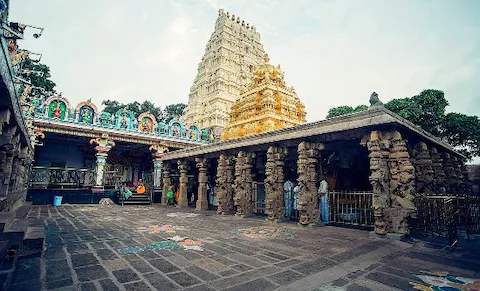
The Srisailam Mallikarjuna Temple showcases classic Dravidian architecture, adorned with intricately carved pillars, towering gopurams, and sacred mandapams that echo stories from the Puranas. The stone walls narrate centuries of devotion, reflecting contributions from dynasties like the Satavahanas, Chalukyas, Kakatiyas, and Vijayanagara rulers.
Walking through the temple corridors feels like stepping back in time where chants of “Om Namah Shivaya” resonate through history itself.
Unlike many pilgrimage sites, Srisailam Mandir offers devotees the rare opportunity to worship both divine energies together. Devotees believe that darshan at the Mallikarjuna Jyotirlinga Temple helps remove past karmic burdens, while blessings from Goddess Bhramaramba grant strength, clarity, and protection.
This divine duality is why Srisailam Temple is considered a spiritually complete destination for Shiva devotees.
From early morning Abhishekam to the deeply powerful Sparsha Darshan, the rituals at Srisailam Mallikarjuna Temple are performed with ancient precision. Festivals like Maha Shivaratri, Karthika Masam, and Navaratri transform the entire town into a vibrant sea of devotion, lamps, chants, and divine energy.
During these sacred times, Srisailam becomes a spiritual magnet, attracting devotees from across India and beyond.
Surrounded by dense forests and dramatic hill landscapes, Srisailam Andhra Pradesh offers more than temple darshan. The natural surroundings amplify the spiritual experience, allowing devotees to disconnect from worldly chaos and reconnect with inner peace.
The tranquil flow of the Krishna River, the silence of the forests, and the sacred hilltop location make Srisailam an ideal destination for meditation, reflection, and spiritual renewal.
Srisailam is famous because it is home to the sacred Mallikarjuna Jyotirlinga, one of the twelve Jyotirlingas of Lord Shiva in India. What makes Srisailam Temple unique is that it is also a revered Shakti Peetha, where Goddess Bhramaramba Devi is worshipped. This rare presence of both Shiva and Shakti together makes Srisailam a spiritually powerful destination for devotees.
Srisailam is located in the Nallamala Hills of Andhra Pradesh, along the banks of the River Krishna. Surrounded by dense forests and scenic hills, Srisailam Andhra Pradesh is both a spiritual and nature-rich destination, offering a peaceful atmosphere for pilgrims and travelers alike.
The best time to visit Srisailam Temple is between October and March, when the weather is pleasant and ideal for temple visits and sightseeing. The temple becomes especially vibrant during Maha Shivaratri and Karthika Masam, though these periods also attract large crowds of devotees.
Absolutely. While Srisailam Temple is a major pilgrimage site, the region also offers beautiful natural attractions such as Pathala Ganga, Srisailam Dam, forest viewpoints, and serene river landscapes. This makes Srisailam an ideal destination for travelers seeking both spiritual depth and natural beauty.
A 2 to 3-day trip is ideal to fully experience Srisailam, Andhra Pradesh. This allows sufficient time for temple darshan, participation in rituals at the Mallikarjuna Jyotirlinga Temple, and exploration of nearby scenic and spiritual attractions without rushing.
Visiting Srisailam Temple is not merely a religious journey - it is a transformational experience. Whether you seek divine blessings, spiritual awakening, or historical depth, Srisailam offers all of it in one sacred destination.
The presence of the Mallikarjuna Jyotirlinga, the ancient legends, the powerful rituals, and the serene natural beauty together make Srisailam Mandir one of India’s most profound spiritual landmarks.
A journey to Srisailam, Andhra Pradesh is a journey into devotion, legend, and living history. For Shiva devotees, this sacred land is not just a destination - it is a divine calling. Standing before the Mallikarjuna Jyotirlinga, one truly understands why Srisailam has remained timeless in India’s spiritual heart.
Why Vijayawada, Andhra Pradesh Is Famous: History, Culture & Must-See Attractions
If you’re curious to explore more of Andhra Pradesh’s rich heritage, don’t miss our detailed guide on Vijayawada, Andhra Pradesh. From ancient temples and cultural landmarks to vibrant city life, this blog beautifully captures another iconic destination that reflects the true spirit of the state.